Home
/
RELIGION & LIBERTY ONLINE
/
What can protestants expect from the new pope?
Jan 13, 2026 9:18 PM

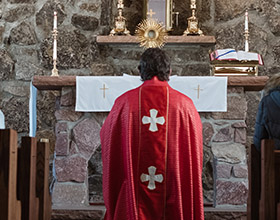
In an excellent survey of the writings of Cardinal Ratzinger, Michael S. Horton explores some of the implications of the election of Pope Benedict XVI for Protestantism. After providing a brief background of the relationship between Ratzinger and Pope John Paul II, Horton addresses “some of the representative statements by Joseph Cardinal Ratzinger, to obtain a better idea of what we might expect from his pontificate. Hopefully we will see that there is much to appreciate in an age of increasing pressure to conform the church’s message to the spirit of the age, while also recognizing the distance that remains between genuinely evangelical churches and the Bishop of Rome.”

I find that the heart of the matter lies in the observation that “those who argue for orthopraxis over orthodoxy forget that with this ‘facile’ and ‘superficial slogan,’ that ‘the contents of orthopraxis, the love of neighbor, radically change (always, but today above all) in keeping with the manner and way orthodoxy is understood’ (23).” In this way, the proper understanding of the relationship between orthodoxy and orthopraxis acts as a check on the tendency to understand unity purely in practical terms, at the expense of doctrinal concord.
Comments
Welcome to mreligion comments! Please keep conversations courteous and on-topic. To fosterproductive and respectful conversations, you may see comments from our Community Managers.
Sign up to post
Sort by
Show More Comments
RELIGION & LIBERTY ONLINE
Radio Free Acton: A.J. Jacobs on coffee and gratitude; The story of freedom in Estonia
On this episode of Radio Free Acton, producer Caroline Roberts speaks with A.J. Jacobs, journalist and New York Times bestselling author, about his latest book “Thanks a Thousand,” detailing his trip around to world to find and thank each person who worked to produce his morning coffee. After that, senior editor at the Acton Institute, Rev. Ben Johnson, speaks with Estonian politician Mari-Ann Kelam about her witness of Soviet occupied Estonia and her work to champion freedom even after the...
What labor force participation is (and why it matters)
Note: This is post #103 in a weekly video series on basic economics. Labor force participation is an important concept connected to employment. The labor force participation rate is defined as the section of working population in the age group of 16-64 in the economy currently employed or seeking employment.The formula for the labor force participation rate is therefore rather simple: labor force (unemployed + employed) / adult population, excluding people in the military or prison for both. The total...
Great Dominicans, Good Society: Successful Acton Rome conference
On Tuesday, the Acton Institute and its Rome office concluded another very successful international conference, Freedom, Virtue and the Good Society: The Dominican Contribution. The 380-person overflow attendance at the Pontifical University of St. Thomas Aquinas (the Angelicum) included participants from the Angelicum itself and other pontifical universities, various religious and missionary orders, diverse sectors of business, non-profits and political leadership, as well as representatives from diplomatic corps to the Holy See. The Angelicum’s Dean of Social Sciences, Fr. Alejandro...
Lacordaire: penitent religious, unrepentant classical liberal
As our Acton Institute prepares for its Rome conference tomorrow, December 4, on the Dominican contribution to “Freedom, Virtue, and the Good Society”, extraordinary men and women from the Order of e to mind: Albert the Great, Catherine of Siena, and perhaps the most famous of all, the Angelic Doctor, Thomas Aquinas. Together these medieval stalwarts of the faith, truth, and justice laid the groundwork for modern science, modern learning, and even modern politics. The great Dominican heritage may have...
The return of ‘Tariff Man’, nemesis of the poor
“I am a tariff man,” said the Republican president. He based his strong support of tariffs on the idea that industries within the U.S. needed “protection” from petition. A vocal opponent of free trade, his view was that America could tax its way to prosperity. Prices on consumer good rose, which helped to cause the Republicans to lose their majority in the House. But “tariff man” never wavered from his protectionist impulses, no matter how much damage they caused. By...
Maslow, material needs, and the gospel
“Human beings are created with bodies and souls,”says Jordan Ballor in this week’s Acton Commentary. “We have both material and spiritual needs.” Earlier this year, Susan Mettes of Christianity Today critiqued the use of Maslow’s hierarchy of needs as a ministry tool. The central idea of the hierarchy, as Mettes puts it, is “that physical needs must be met before people experience spiritual needs.” Mettes argues against such a dualistic perspective, and instead points out that the Bible places a...
Against consumption Phariseeism: When minimalism and materialism collide
In a recent reflection on Christmastime consumerism, I explored the underlying challenges and opportunities of creativity and generosity in a free economy, arguing that the forces of materialism can be e if we maintain the right heart/mind orientation. “Economic growth and increasing prosperity are not identical with consumerism,” writes John Bolt in Economic Shalom. “Though it is a demanding challenge, one can be both wealthy and a faithful steward of God’s gifts.” Yet, lest we forget, such an integration is...
A free and virtuous society: Lessons from Les Misérables
Interpreting works of literature is always a dicey task—it’s all too easy to find the conclusions we want to find and turn authors into spokesmen for our own ideas. In these reflections on Victor Hugo’s Les Misérables, I don’t claim that what I say is necessarily what Hugo himself intended. That said, though, his unforgettable story gives worthwhile insights into the workings of a free and virtuous society. There’s a reason the novel’s title is seldom translated into English—misérables means...
Avoiding ‘beepocalypse’: What beekeeping entrepreneurs teach us about stewardship
Over the past decade, we have received many resounding warnings of an impending “beepocalypse”—and for good reason. Honeybee mortality rates have spiked and scientists are still struggling to pinpoint the cause, posing a range of environmental concerns and putting many important crops at risk. According to the U.S. Department of Agriculture, bees add $15 billion in annual revenue to the economy. Yet amid the increase in bee mortality—attributed to something called colony collapse disorder (CCD)—the country’s beekeeping entrepreneurs have quietly...
The Christian life and the common good
In this week’s Acton Commentary I show that the idea that “physical needs must be met before people experience spiritual needs” is older than Maslow’s famous hierarchy of needs. The key to understanding how this might be lies in a distinction between the order of time and the order of being. The church father Augustine noted that such distinctions have some important social and economic implications. Even though the mouse is higher on the chain of being than the piece...
Related Classification
Copyright 2023-2026 - www.mreligion.com All Rights Reserved