


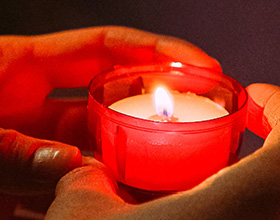
Christianity proclaims the future regeneration of a disordered world. The Church is an earthly reminder of that day of restoration. The Body of Christ, gathered together on Sunday mitted to the work of regeneration at all times, offers a refuge forting place for questions of "Why?" especially during disasters and trial. Through the ages, it has held to the hope of a brighter day. After springtime tornadoes tore through Alabama, the Rev. Kelvin Croom at College Hill Baptist Church in Tuscaloosa put it this way as he surveyed his devastated city:
Even in the days we were living with segregation, we all had a hope for a better day. And right now, that's what we're doing in Tuscaloosa: We're hoping for a better day, hoping e from the ashes of destruction and into a beautiful, more livable American city.
Many families and individuals understandably ask "Why?" after tornadoes wreaked havoc across the South in late April and in Joplin, Missouri, the following month. The 2011 death toll from tornadoes in the United States has topped 520, making it the deadliest tornado season since 1953. The 2011 death toll has almost matched the prior number of the last ten bined.
During these disasters, concerns about continued government spending and a recession has given increased attention to the role of private charities. The stories, in many cases, are not just inspirational, but provide models of effective disaster relief.
With government assistance often bureaucratic and slow to respond, Christian charity and church organizations are a vital source of relief fort. "Pastors usually know munity better than government officials . . . While the government talks about systems and infrastructure problems, faith-based organizations are able to provide immediate assistance thanks to established relationships with churches on the ground," said Franklin Graham, CEO and president of Samaritan's Purse.
In Shoal Creek, Ala., a frustrated Carl Brownfield called the federal response "all red tape." The Birmingham News ran a story on May 10 reporting that a "low number" of Alabama residents had applied for federal assistance for various reasons including being "leery of government help."
After the experience of Hurricane Katrina in 2005, many church agencies and religious groups are now seasoned veterans when es to disaster response. They have learned from their own mistakes and built networks to empower their efforts. Along the Mississippi Gulf Coast, Christian agencies and churches rushed out with chainsaws to clear private properties and roads so that hot food tents could be up and running the next day. "I was amazed at the quickness Southern Baptist Disaster Relief cut through the rubble to meet immediate needs," said one Katrina survivor. The Southern Baptists' North American Mission Board raised a total of $25 million to assist Hurricane Katrina victims. An American Red Cross representative in Alabama said, "I don't believe the Red Cross could do what it does in terms of feeding people without the Southern Baptists." She described the Southern Baptist food delivery system as a "welloiled machine."
Many church groups have their own state of the art field kitchens that can easily feed 25,000 a day. But perhaps the greatest faith witness to effectiveness is the mitment churches and faith groups have made to rebuild the Gulf Coast. Six years after Katrina, in towns like Grand Isle, and Grand Bayou, La., volunteers are still getting up before the sun, attracting little fanfare as they give of their time and labor. They call this a "blessing" and a "form of worship."
After Katrina, an army of Mennonite, Amish, and evangelical volunteers from Lancaster County, Pa., showed up to lend a hand at a church in Pass Christian, Miss. A conservative dollar estimate of their labor contribution was $1.3 million. The volunteers donated just over $1 million in equipment and supplies. Business leaders pitched in as well, as the employer of a pany from that munity paid his workers during the relief effort. These stories mon all along the Gulf Coast.
On May 22, 2011, Joplin, Missouri was struck by a tornado resulting in at least 151 deaths.
After tornadoes struck Alabama, large churches like Frazier United Methodist Church in Montgomery were teaching volunteers how to use chainsaws the next day. It was a testament to the network, skills, and expertise found in many churches when es to disaster response.
"The churches are far better about getting out of their buildings now," said Randy Gariss, pastor of College Heights Church in Joplin. "Before it was more of a bunker mentality with some churches because of the cultural wars, but so many more churches are building relationships with the munity." College Heights Church is heavily involved in the recovery effort.
Using the tremendous resources of the church, Gariss is helping to lead a recovery that he calls "relational." He sees the focus moving from initial response to empowering parishioners to distribute services and money through the ties and relationships that are already established in munity.
In a meeting with President Barack Obama in Joplin, Gariss shared something the president whispered into his ear after he finished speaking. "The president told me it would be the munity and not the government that will make this [rebuilding and restoration] happen."
University of Alabama professor David T. Beito called the relief efforts in Tuscaloosa "extremely decentralized" and added, "I don't know if a more secular city would fare nearly as well." In an interview, Tuscaloosa resident Jeff Bell declared of the recovery, "What I am seeing is spiritually amazing. Black and white churches are forming a bond as well as all different denominations." Bell, who took shelter in the basement of a Baptist Church, prayed what he thought would be his final prayer. After the storm, he ran over to assist those injured in a nearby barbecue restaurant that was demolished by the winds. Bell said:
I met a young University of Alabama student who is a nursing major and she came to the scene to help. I am telling you, I saw the face of God in this girl and she is a born leader. She showed up and helped calm a traumatized woman. This girl was very poised passionate.
Bell, who lost his job because of the devastation, said the munity has been very active in the response. "Small business owners who have lost everything are finding ways to help their employees," he said. panies entrenched in munity have pledged sizeable financial gifts. Hyundai Motor Company has already pledged $1.5 million to the relief effort in Alabama. In Joplin, Walmart and Home Depot have each pledged $1 million to recovery efforts. Tamko Building Products, Inc., based in Joplin, has also pledged a gift of $1 million for those affected by the tornado in Missouri. Coincidentally, pany had just finished rebuilding a plant in Tuscaloosa that was devastated by the storm.
Social networking sites have been instrumental in relief efforts after the tornadoes, modeling spontaneous order. Much of the relief effort is not top to bottom but grassroots driven. Toomer's for Tuscaloosa, which has partnered with the Christian Service Mission, is a group of Auburn University sports fans who have united on Facebook to reach out to their in-state rivals. Their network has surpassed 86,000 people. Fans post a need and somebody responds nearly instantaneously to address the situation or share updates. Their reach, which has grown tremendously, is allowing them to assist Mississippi River flood victims, the tornado munity of Smithville, Miss., and Joplin. In a letter thanking the governor of Alabama for his leadership during the crisis, Toomer's declared:
In one way or another, none of this would have been possible had you not minimized the red tape for this faith-based volunteer support initiative, our ability to get to affected areas was largely due to a lack of resistance from a governor who truly believes in the citizens of his state.
In Joplin, Gregory Mech, who pastors Immanuel Lutheran Church, says they had to hire a person full time just to answer phones. "One of the first calls we had from people who wanted to help came from Cameroon [Africa]," he said. Like many churches in the area that still have a structurally sound building, their church is open for food, medical care, and supplies. They even have a pharmacy on their church plete with doctors and nurses. A parishioner at the church recalled:
The word about our facility has spread and many tired, hungry families and rescue workers are getting hot meals, medical care, and supplies. When they walk in our gym, you should see their faces. They are overwhelmed by the love of Christ that is being lavished on them. Thank you for standing with us through this incredibly tough time. The Body of Christ is beautiful!
In the Old Testament account of Job, a mighty wind swept in from the desert and killed all of his sons and daughters. As we know from the story, it was just the beginning of Job's suffering and laments. God, however, was not silent in Job's suffering and spoke out of the whirlwind (Job 38:1).
A tree lies uprooted near graves and tombstones after a tornado left a path of destruction in the cemetery on April 16, 2011 in Raleigh, NC.
The old Isaac Watts hymn "Our God, Our Help in Ages Past" calls the Lord a "shelter from the stormy blast." The Psalmist declares, "We went through fire and through water; yet you have brought us out to a place of abundance."
The Church has debated and discussed the problem of evil from its earliest days. But it's clear that a God that called his own Son to suffer to restore humanity, likewise promises that his followers won't be free from suffering on earth. The agony of Christ allowed for the restoration of humanity. Christianity proclaims that adversity has brought abundant life. The Apostle Paul declared in his letter to the Philippians that he wanted to know Christ more by participating in his "sufferings."
Lee and Sharon Sandifer of Slidell, La., lost everything after a 15-foot storm surge during Katrina washed through their residence. They simply hauled all their possessions out to the street and marked it with a sign: "This pile of stuff was not our life; our life is hid in Christ."
It is of little wonder that a faith that believes that all healing flows from Christ is leading the restoration munities, no matter how broken or barren munities may appear from plain sight. It is, after all, simply a model of the Incarnation.







 zpostcode
 Recruit
 weather
 mreligion
 Yellowpages
 sport
sport constellation
 shopping
 name
name game
game directory
 literature
 Word
Word tour
tour furnish
 Lottery
 tftnews
 lyrics
 News
News digital
 car
car dir
dir Edu
Edu Finance


