


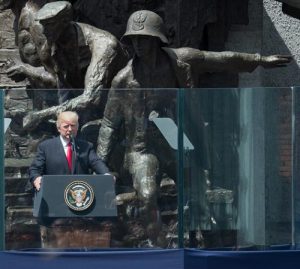
During a remarkable speech this morning in Warsaw, President Trump did something that many believed impossible: He spoke clearly – eloquently, even – as he passionately defined and defended transatlantic values. Unlike so many of those who parrot the phrase, he began by describing what those values are. Standing at the site of the Warsaw Uprising, he said that Western civilization is embodied in faith, family, economic vitality, limited government, national sovereignty, intellectual freedom, and the pursuit of excellence. Those values are imperiled by Islamist terrorism, EU bureaucracy, and a loss of inner purpose. And despite the rift between the U.S. and EU leaders, “the transatlantic bond between the United States and Europe is as strong as ever.”
The choice of Poland as a backdrop proved illustrative of both the promise and the peril facing the West.
“Through four decades of Communist rule, Poland … endured a brutal campaign to demolish freedom, your faith, your laws, your history, your identity; indeed, the very essence of your culture and your humanity,” the president said. Yet despite the onslaught of a soulless system, the Polish people “stood in solidarity against oppression, against a lawless secret police … and you won. Poland prevailed. Poland will always prevail.”
He pinpointed the moment he believed that freedom began its public resurgence: June 2, 1979. A quarter of a million Poles gathered for a Mass celebrated by “Saint John Paul II,” as the Presbyterian president called him. The open-air event culminated with the chant, “We want God!”
Trump continued:
As I stand here today before this incredible crowd, this faithful nation, we can still hear those voices that echo through history. Their message is as true today as ever. The people of Poland, the people of America, and the people of Europe still cry out, “We want God!”
That proclamation of faith shattered the militant atheism of the Brezhnev era. But one of today’s key threats perpetrates its atrocities in the name of its own conception of God. “Radical Islamic terrorism,” he said, is an “oppressive ideology” that “seeks to export terrorism and extremism all around the globe.” Intelligence sharing is one part of the battle against Islamism, as are joint NATO defense exercises. To fund these, every nation must contribute its prescribed (and freely agreed upon) share of the defense budget.
But defending society means denying entry to specific individuals who would threaten our safety. “While we will always e new citizens who share our values and love our people,” Trump said, “our borders will always be closed to terrorism and extremism of any kind.”
Interestingly, Donald Trump placed alongside the danger of radical Islam the menace of bureaucracy and economic interventionism. He described Marxism as “a cruel and wicked system that impoverished your cities and your souls.” Today, the West is threatened by a stealthier enemy: “the steady creep of government bureaucracy that drains the vitality and wealth of the people.” His wording sounds much like the description of the Social Assistance State in Centesimus Annus.
“The West became great, not because of paperwork and regulations, but because people were allowed to chase their dreams and pursue their destinies,” Trump said.
The target of his criticism es clear if one remembers that, as Trump rolled back the worst excesses of the Obama administration’s regulatory overreach, the UK was deciding how best to codify between 12,000 and 19,000 separate EU rules and regulations into domestic law.
Similarly, he spoke of NATO as “a strong alliance of free, sovereign, and independent nations” – with little room for the Eurocrats’ vision of an “ever-closer union.”
Trump was at his strongest rhetorically, not when describing the problems that beset us, but the characteristics that represent the better angels of our nature. Centralized regimentation simply does not reflect the fabric of the Western soul.
“We put faith and family, not government and bureaucracy, at the center of our lives,” he said.
The West is an entrepreneurial society, characterized by a dynamic economy that allows everyone to thrive to the full extent of his (or her) talents. “We pursue innovation,” he said. “We reward brilliance. We strive for excellence and cherish inspiring works of art that honor God. We treasure the rule of law and protect the right to free speech and free expression.”
Admitted, he signaled a more interventionist policy on trade earlier in the day during his press conference with Polish President Andrzej Duda. But he likely had Paris climate agreement in mind when he said, “We debate everything.”
“We empower women,” he continued, emphasizing the equality, if not the interchangeable nature, of the sexes. “Above all, we value the dignity of every human life, protect the rights of every person, and share the hope of every soul to live in freedom.”
When European leaders discuss transatlantic values, the American president argued, these qualities should define the term.
“That is who we are,” he said. “Those are the priceless ties that bind us together as nations, as allies and as a civilization.”
The question hanging over the West is whether its citizens, especially those in Western Europe, will embrace and fight for this concept of society. The greatest threat, he made clear, is the paralyzing self-doubt that, as Douglas Murray wrote, leaves Europe “little desire to reproduce itself, fight for itself, or even take its own side in an argument.”
And thus, Donald Trump returned to his backdrop in Warsaw. “The Polish experience reminds us, the defense of the West ultimately rests not only on means, but also on the will of its people to prevail and be successful,” he said.
“Together let us all fight like the Poles, for family, for freedom, for country, and for God,” he concluded.
If Donald Trump seems an unlikely candidate to rouse the West to “fight … for God,” the sentiment remains e, the prescription remains the correct one, the antidote remains the only lasting hope of deliverance.
As the G20 Summit begins, EU leaders will undoubtedly negotiate, cajole, bray, and needle the president to embrace their view of Western society, premised upon their “values.” They will try to bargain away the past they rejected and that most Americans accept. Whatever they decide, the West is richer for these values having been placed on the table – and poorer that they had to be.
Hakes. White House Facebook page. This photo has been cropped and modified for size. Public domain.)




 zpostcode
 Recruit
 weather
 mreligion
 Yellowpages
 sport
sport constellation
 shopping
 name
name game
game directory
 literature
 Word
Word tour
tour furnish
 Lottery
 tftnews
 lyrics
 News
News digital
 car
car dir
dir Edu
Edu Finance


